For this week's post I will just leave you with a list. Everyone does top 10 lists; so, I will switch it up and do a top 7 list. Specifically this is my top 7 favorite game mechanics or design choices. These mechanics are in no particular order.
1) Laying out cards players can choose from
I choose this simple mechanic because I remember how it first struck me. I had grown up my whole life playing games where you always got your cards off of the top of the deck. Whether when initially dealt or later given more cards, I always got a random card off the top of the deck because that is how all of the games I knew played. Then I played Ticket To Ride for the first time and, while I could still draw off the top if I wanted, I also had a choice of 5 other cards to choose from. Moreover, they were laid out face up so I knew what they were. It was such a simple mechanic, but made so much sense to me. Now I know that other games have done things like this before Ticket To Ride. Heck, Texas Hold 'em has been around for a long time and it has cards laid out for people to see and use. Nevertheless, it is a great way to reduce the randomness without completely eliminating it, and (as I have mentioned in previous posts) a key to great game design is that balance of randomness in a game.
2) Two meters (or point trackers) one must balance
This is one that I haven't been able to write much about and will likely devote a whole post too soon. The game I know this mechanic from is Pillars of the Earth. In that game, you essentially have 2 meters you must balance. One is money and the other is victory points. Certainly, many games have money and victory points that you want to gather. Pillars of the Earth, like many other games, has you spend that money to get resources and workers that allow you to garner victory points. However, Pillars of the Earth really forces you to carefully balance the amount of money you spend against the number of victory points you accumulate for each round. No other game I have played makes it so important to keep that balance.
3) Allowing players to use different special abilities together
I feel like there is a better description for this mechanic, but I couldn't think of how else to say it, and I need to get to bed. (A 9 month old daughter will make you want to sleep a lot while preventing you from sleeping as well as you used to. :-) Pandemic is still my favorite game (as you can now see on boardgaming.com), and this is what it does very well. Each player role has their own special abilities. Working together in that cooperative game, it is imperative that players work together and use those special abilites as much as they can. For example, the Researcher and the Dispatcher really work beautifully together. The Dispatcher can move the Researcher to any city that another player is in. Then on the Researcher's turn, he/she can give cards to that player he was moved to (since they are now in the same city).
BTW, yes, I thought about having "roles" as a fav mechanic, but I have really seen some games that seem to just throw roles in for the fun of it. Shadows Over Camelot felt that way to me because the roles special abilities didn't seem to be useful enough to have a great impact that one would cause one to alter strategy greatly. If the roles don't impact the game greatly, I think they only complicate things.
4) Deck-building (but not collectable)
Deck-building really has become a category thanks to all the games trying to capitalize off of Dominion's success. Nevertheless, it is a mechanic that really dictates the game-play. Many gamers are probably getting sick of deck building with the seeming over saturation hitting the market right now. Once again, I must say nevertheless. Nevertheless, Dominion is a great game. Almost every one I have introduced to that game loves it until they have just played it too much. There is just something fun about grabbing cards in the middle that are available to everyone and then comboing those cards together later in the game to amass the most splendid and/or powerful dominion.
To explain the parenthesis above: I like deck building as seen in Dominion where you start out with almost nothing, have access to the same cards, and build as the game goes. I am not personally a fan of games like Magic where you bring your own deck to the table that you built outside of that game session.
5) A randomized board
When I played Settlers of Catan for the first time, there was one main thing that struck me: the board is different every time because it is made up of randomly placed hexes. I thought that was brilliant then, and I still think it is brilliant now. One instantly, greatly increases the replayability of the game when the board can change each time. There isn't much else to say. As long as it works for the game to have a randomly composed board (so that it doesn't cripple the game play or fun in some way), I think a design would want to implement such a board every time. Not only does it make each game session different, requiring interesting adjustments to strategy, but it also makes it easier to fit in a box for shipping.
6) The Back To The Future timeline
When I heard that the Back to the Future card game (and Chrononaughts before it) allowed people to travel back in time and change events, I was very curious and intrigued as to how it would accomplish that. As described in a previous post, the game is good but slightly disappointing. However, the mechanic for time travel and changing events did not disappoint. The cards are laid out in a set of rows with the linchpin cards flipping multiple other cards when they are flipped. That method is simple and effective.
7) Movement chips in Scotland Yard
Scotland Yard requires players to be able to move around the board. Movement is a significant design challenge for any game. Of course, all of the games I played as a child used, "roll and move" in which you roll a die and then move the number of squares that the die dictates. Of course, "roll and move" eliminates the ability to strategize. I thought Scotland Yard came up with a pretty interesting method for movement. Each player has a number of different chips, and there are 3 different types of chips. Those chips essentially allow players to move different distances. They have a limited number of the chips and must decide when to use what chip types. It provides a great way for players not to have unlimited range of movement but still have a good amount of control over how and where they move. While I wouldn't say Scotland Yard is a game I really love, I do think the movement is handled well.
Wednesday, September 14, 2011

Wednesday, September 7, 2011
In pursuit of quality, useful board game reviews
Well, if you haven't noticed, the startingPlayer blog took a bit of a vacation. I do plan to get back to regular, weekly posts. Here is something I thought I'd share with you that would be worthy of a post. There is a new board game website going up called boardgaming.com. First, I have to congratulate them on a great domain name. A good domain name is crucial for a website, but that is a topic for another day.
They were wondering how a site like theirs could encourage quality game reviews on the site. I have pondered this question long and hard even before they asked it because, at one point, I was thinking of starting my own board game reviews website. When I started examining it, I came down to this question: Why is it that I keep coming back to GiantBomb.com for my video game reviews and only go to other sites when they don't have a review of the game or I want more opinions? I came to the conclusion that it was because I knew and liked the editors, and I am familiar with the community and its trends or communal attitudes. Given that previous thinking and examining I'd done on the subject, here is the info recommendation I posted as a comment on boardgaming.com's article.
They were wondering how a site like theirs could encourage quality game reviews on the site. I have pondered this question long and hard even before they asked it because, at one point, I was thinking of starting my own board game reviews website. When I started examining it, I came down to this question: Why is it that I keep coming back to GiantBomb.com for my video game reviews and only go to other sites when they don't have a review of the game or I want more opinions? I came to the conclusion that it was because I knew and liked the editors, and I am familiar with the community and its trends or communal attitudes. Given that previous thinking and examining I'd done on the subject, here is the info recommendation I posted as a comment on boardgaming.com's article.
Sunday, August 14, 2011
Board game refreshment: being wowed
It had been a while since I had been wowed by a game. Now, when I say wowed, I’m not talking about being “blow away” from surprise or something, but by wowed, I simply mean that I played a new game and really thought it was great; not just good, but something I very much enjoyed, wanted to play again, and thought I’d like to go out and purchase immediately. Once again, it had been quite a while since I’d had that “wowed” experience, and that is in spite of playing a number of new games including Yesphan, Back to the Future, Puerto Rico, Ascension, and Space Hulk: Death Angel. That also takes into consideration that I bought Back to the Future and Space Hulk: Death Angel myself and was very excited to play them. When I played them, I found them fun, but I was far from “wowed.” So, I was pleasantly surprised when I was wowed by Roll through the Ages when I first played it a few weeks ago, and I was almost shocked to have it happen again when I played Alhambra last Thursday night.
Roll through the Ages is basically a mix of Civilization and Yahtzee. As per usual, I prefer not to spend too much time on this blog explaining a game. So, if you want extensive details and/or rules, visit boardgamegeek.com. Nevertheless, I will tell you that the main idea of the game is to roll dice that have workers, goods, money, and food on them. You can use goods and workers toward adding moments and developments to your civilization. Just as in the game Civilization, the developments give your people some benefits, such as protection from famine or better money production. Also, you can put workers toward making more “cities” which are dice; so, you can get more dice to roll on future turns (You start with 3 dice.). It sounds simple, and it is, but it is very fun filling in the squares (with what you get via dice rolls) to build your peoples. Moreover, since the developments give you advantages and since the players are competing to complete the same monuments (once one person gets a monument, the others get about half the victory points than what the 1st player got for completing the monument), there is a lot of strategy to deciding what developments to build and what monuments to go after. As I have mentioned in other posts, many of my favorite games that are quite simple and yet still find a way to have a lot of underlying strategy. Roll through the Ages accomplishes that extremely well, and that is why I was so wowed by it. In fact, the games main mechanic (which is essentially Yahtzee) is so straight-forward, my first thought was that the game would only be light, filler fun. (A filler game is just a game that goes fast and can be played quickly before or between other longer board games.) However, as already indicated, I was surprised by the strategy. The game certainly moves fast, meaning it could be a great filler game between playing two longer games, but it also could easily fill a night of gaming, playing multiple games. I have only played Roll through the Ages a few times, but I am sure I will discuss it more later after more plays; then, I will be able to speak even better to its mechanics and replayability.
Alhambra I have only played once: last Thursday night. To relate it to other games, it is probably best described as a Euro, economic game with a mix of Carcassonne. You have to buy buildings to add to your Alhambra, and those buildings must fit in with your current Alhambra. That requirement to fit the piece into your Alhambra is what reminds me of Carcassonne. It is hard to explain; so, here is a video on Alhambra that will explain what I mean (and more since it is a full review). If you want to just see what I am talking about, look at about minutes 2:45 - 3:10 and 3:45 - 4:30.
I am very eager to play Alhambra some more. I really like the way there are always buildings out that you can make work for you. You just have to determine what you will save up for, what you will wait to get exact change for, what you will pass on, and what you will buy simply because it is a good opportunity. It is fun to determine what you will buy per guessing what others are going to buy and seeing what they already have. The ability to easily see what others have is probably what I consider the biggest strength after one play through. Games like Puerto Rico are too complicated for me to focus on what others have; I instead have to focus my entire attention on what I have and what I am doing to keep my strategy straight in Puerto Rico. (That is after playing it about 3 or 4 times.) Alhambra’s rules are simple enough to where I felt I could see what I had and consider what others were doing without losing track. Moreover, it is easy to see what others have by just physically looking since the Alhambra tiles are a good size, well colored (easy to tell the difference between the colors), and laid out in front of the player for all to see. It is not like Roll through the Ages: Roll through the Ages has one problem in which you are making your Xs on a small sheet in front of you; so, it is hard for others to easily see what you are working on. Alhambra doesn’t have that issue. Also, Alhambra does not have the issue that Puerto Rico has: Puerto Rico has many different elements consisting of crops that have to have wood chips on them and buildings that have to have wood chips on them. So, one not only has to keep track of what crops and buildings they have, but they have to keep track of which ones have the wood pieces on them. Finally, the buildings all do different things and are worth different points; so, you have to keep track of that as well. One cannot assess all that just by looking; you have to actually track it as the game goes along. On the other hand, Alhambra allows you to easily assess that each time instead of having to track things in your mind. Once again, it is basically an example of how simple is better than complex if you can still bring a reasonable amount of strategy to the game. Mr. Vasel wasn't as high on his first play as I was; so, I will just tell you: the strategy in Alhambra is great. Once again, I’ve only played it once; so maybe the strategy and replayability falter as you play it more, but I doubt it.
It was nice to be wowed by Roll through the Ages and Alhambra. I would expect there will be more posts about them in the future. Certainly, as I play board games somewhat frequently, some games can start to feel stale. So, it is disappointing at times when there are no games seemingly worthy of my wishlist. Thankfully, Roll through the Ages and Alhambra have stepped up and reminded me that great games are still out there. Now I have a few games for my Christmas list if I don’t get either of them sooner.
Roll through the Ages is basically a mix of Civilization and Yahtzee. As per usual, I prefer not to spend too much time on this blog explaining a game. So, if you want extensive details and/or rules, visit boardgamegeek.com. Nevertheless, I will tell you that the main idea of the game is to roll dice that have workers, goods, money, and food on them. You can use goods and workers toward adding moments and developments to your civilization. Just as in the game Civilization, the developments give your people some benefits, such as protection from famine or better money production. Also, you can put workers toward making more “cities” which are dice; so, you can get more dice to roll on future turns (You start with 3 dice.). It sounds simple, and it is, but it is very fun filling in the squares (with what you get via dice rolls) to build your peoples. Moreover, since the developments give you advantages and since the players are competing to complete the same monuments (once one person gets a monument, the others get about half the victory points than what the 1st player got for completing the monument), there is a lot of strategy to deciding what developments to build and what monuments to go after. As I have mentioned in other posts, many of my favorite games that are quite simple and yet still find a way to have a lot of underlying strategy. Roll through the Ages accomplishes that extremely well, and that is why I was so wowed by it. In fact, the games main mechanic (which is essentially Yahtzee) is so straight-forward, my first thought was that the game would only be light, filler fun. (A filler game is just a game that goes fast and can be played quickly before or between other longer board games.) However, as already indicated, I was surprised by the strategy. The game certainly moves fast, meaning it could be a great filler game between playing two longer games, but it also could easily fill a night of gaming, playing multiple games. I have only played Roll through the Ages a few times, but I am sure I will discuss it more later after more plays; then, I will be able to speak even better to its mechanics and replayability.
Alhambra I have only played once: last Thursday night. To relate it to other games, it is probably best described as a Euro, economic game with a mix of Carcassonne. You have to buy buildings to add to your Alhambra, and those buildings must fit in with your current Alhambra. That requirement to fit the piece into your Alhambra is what reminds me of Carcassonne. It is hard to explain; so, here is a video on Alhambra that will explain what I mean (and more since it is a full review). If you want to just see what I am talking about, look at about minutes 2:45 - 3:10 and 3:45 - 4:30.
I am very eager to play Alhambra some more. I really like the way there are always buildings out that you can make work for you. You just have to determine what you will save up for, what you will wait to get exact change for, what you will pass on, and what you will buy simply because it is a good opportunity. It is fun to determine what you will buy per guessing what others are going to buy and seeing what they already have. The ability to easily see what others have is probably what I consider the biggest strength after one play through. Games like Puerto Rico are too complicated for me to focus on what others have; I instead have to focus my entire attention on what I have and what I am doing to keep my strategy straight in Puerto Rico. (That is after playing it about 3 or 4 times.) Alhambra’s rules are simple enough to where I felt I could see what I had and consider what others were doing without losing track. Moreover, it is easy to see what others have by just physically looking since the Alhambra tiles are a good size, well colored (easy to tell the difference between the colors), and laid out in front of the player for all to see. It is not like Roll through the Ages: Roll through the Ages has one problem in which you are making your Xs on a small sheet in front of you; so, it is hard for others to easily see what you are working on. Alhambra doesn’t have that issue. Also, Alhambra does not have the issue that Puerto Rico has: Puerto Rico has many different elements consisting of crops that have to have wood chips on them and buildings that have to have wood chips on them. So, one not only has to keep track of what crops and buildings they have, but they have to keep track of which ones have the wood pieces on them. Finally, the buildings all do different things and are worth different points; so, you have to keep track of that as well. One cannot assess all that just by looking; you have to actually track it as the game goes along. On the other hand, Alhambra allows you to easily assess that each time instead of having to track things in your mind. Once again, it is basically an example of how simple is better than complex if you can still bring a reasonable amount of strategy to the game. Mr. Vasel wasn't as high on his first play as I was; so, I will just tell you: the strategy in Alhambra is great. Once again, I’ve only played it once; so maybe the strategy and replayability falter as you play it more, but I doubt it.
It was nice to be wowed by Roll through the Ages and Alhambra. I would expect there will be more posts about them in the future. Certainly, as I play board games somewhat frequently, some games can start to feel stale. So, it is disappointing at times when there are no games seemingly worthy of my wishlist. Thankfully, Roll through the Ages and Alhambra have stepped up and reminded me that great games are still out there. Now I have a few games for my Christmas list if I don’t get either of them sooner.
Saturday, August 6, 2011
Settlers of Catan: what contributed to its success?
When I started gaming over lunch at work, we played started with these games in this chronological order: Pandemic, Ticket To Ride, Settlers of Catan (that's if I remember correctly). If you don't know what Catan is like, you can get it cheap on iPhone or Android. There are also unofficial, free versions that can be found online. There are multiple There isn't much to say about Settlers of Catan. It might be considered THE classic since it started the wave that is modern, strategy/euro board games. However, it still gets mixed reviews when I talk to people about it. Some casual gamers who haven't played it much tell me they "can't figure it out." More serious gamers tell me that there isn't enough strategy or the rolling makes it too random. Correspondingly, Settlers of Catan is #67 on boardgamegeek's current ranking of games, giving a good idea of how it is good (in the top 75 even being over a decade old--newer games tend to get better rankings just because they are new and trendy), but there are still many games above it in the list.
Nevertheless, as I study board games for this blog, I just don't see any before Catan that did what it did. (Please leave comments if I am wrong and many other games had done what I mention below.) Regardless of what the "hard core" board gamers may like to tell you, it has a strong element of strategy, especially when compared to the games of its day.
The strategy comes in placement of your settlements. Often one will try to place there settlements where the numbers are likely of being rolled such as 6s or 8s. Also, it is of course good to be on as many numbers as possible. That way when a number is rolled, one can consistently be gathering resources because they have many numbers covered. Nevertheless, there are more strategies still. If one cannot get to other numbers (because they are blocked by other players) they can instead to collect a lot of one resource, grab that resource's port and then trade with the bank at 2:1 to get the resources you need. Of course, there are other strategies as well. It just depends on what other players do and what resources you get via the rolls. That is maybe the most important thing: you must adapt as the game goes along. The game has a nice balance of things to do with the different card combinations needed to complete roads, settlements, cities, and development cards. So, one can utilize that balance to properly adjust their strategy to the cards and settlements/cities that they have.
I just haven't found games that have been able to accomplish such a nice setup for strategy while being so simple and, thus, accessible. Other games before, had strategy, but even games as simple as Risk were not accessible to many people. Catan has been able to bridge that gap between strategy and accessibility better than Risk. That is due in part to the theme (some people just don't like any kind of war game) but is ultimately successful because it only takes a few turns to have the basic idea down. Then once one gets into it more, they realize there is more strategy than expected. They find that they can get better as they play it more because they can see the different strategies they can adapt to (or bounce between) as the game progresses. That increases replayability, giving people a reason to continue playing it instead of getting bored with it and leaving it on the shelf. So, it is replayable and accessible, and that is what makes it brilliant. At the time in America, the only real options were games like Battleship and Monopoly, which got boring fast and collected dust on the shelf, or games like Risk or Axis & Allies, which simply don't have a theme and simple enough mechanics to make them appealing and accessible to many people. So, board games may have advanced, now offering many more options that have just as good, if not better, strategy elements, and some of those may even be more accessible than Catan. However, Catan is still a classic, and there is a reason I brought it to lunch to play, and there is a reason that it is still 67 on boardgamegeek.com's list when the far majority of the games on that list were published in 2002 or later.
 |
| It is all about placing your settlements on hex intersections of hexes whose numbers get rolled a lot. From Settlers of Catan image gallery on boardgamegeek.com |
The strategy comes in placement of your settlements. Often one will try to place there settlements where the numbers are likely of being rolled such as 6s or 8s. Also, it is of course good to be on as many numbers as possible. That way when a number is rolled, one can consistently be gathering resources because they have many numbers covered. Nevertheless, there are more strategies still. If one cannot get to other numbers (because they are blocked by other players) they can instead to collect a lot of one resource, grab that resource's port and then trade with the bank at 2:1 to get the resources you need. Of course, there are other strategies as well. It just depends on what other players do and what resources you get via the rolls. That is maybe the most important thing: you must adapt as the game goes along. The game has a nice balance of things to do with the different card combinations needed to complete roads, settlements, cities, and development cards. So, one can utilize that balance to properly adjust their strategy to the cards and settlements/cities that they have.
I just haven't found games that have been able to accomplish such a nice setup for strategy while being so simple and, thus, accessible. Other games before, had strategy, but even games as simple as Risk were not accessible to many people. Catan has been able to bridge that gap between strategy and accessibility better than Risk. That is due in part to the theme (some people just don't like any kind of war game) but is ultimately successful because it only takes a few turns to have the basic idea down. Then once one gets into it more, they realize there is more strategy than expected. They find that they can get better as they play it more because they can see the different strategies they can adapt to (or bounce between) as the game progresses. That increases replayability, giving people a reason to continue playing it instead of getting bored with it and leaving it on the shelf. So, it is replayable and accessible, and that is what makes it brilliant. At the time in America, the only real options were games like Battleship and Monopoly, which got boring fast and collected dust on the shelf, or games like Risk or Axis & Allies, which simply don't have a theme and simple enough mechanics to make them appealing and accessible to many people. So, board games may have advanced, now offering many more options that have just as good, if not better, strategy elements, and some of those may even be more accessible than Catan. However, Catan is still a classic, and there is a reason I brought it to lunch to play, and there is a reason that it is still 67 on boardgamegeek.com's list when the far majority of the games on that list were published in 2002 or later.
Friday, July 29, 2011
Ticket To Ride: what makes it great
Usually when I write about a game, you may have no way to truly understand what I am talking about until you buy the game. However, the great thing about Ticket To Ride is that you can go to daysofwonder.com and play Ticket To Ride right now for free (for a trial period). I understand that they also have iPad and iPhone/pod versions of the game. So, go play it now. You'll be glad you did. It is a great game. One of the best for introducing new players to new strategy games and also a great one to play with a family of non-gamers who say they "don't like to think too hard."
So, as we normally do on this blog, let's analyze what makes the game, in this case Ticket To Ride, so great. First of all, the rules are simple. Players may not understand right away, but it will only take a turns and they will have the hang of it. People cards, they play those cards to lay track, only one player can use each track, and they want to complete the routes on their tickets any way they can. The nice thing about this simplicity is that it still allows enough variation for one's strategy to change every game in terms of how many tickets they take, when they lay down trains, and where they they their trains. (In other words, it is not too simple.)
Second, the train cards (which players use to lay down trains) always have 5 out, face-up at time. Players can choose from those 5 or take 1 off the top of the shuffled deck. Randomness is always something that strategy games need to mitigate and having 5 cards out accomplishes that mitigation nicely. Certainly, sometimes the randomness still ruins a player in that the color they need doesn't show up; nevertheless, it is much, much better than if players always had to draw off the top, being completely subject to the randomness of the deck. In fact, I am certain that Ticket To Ride would be ruined if players always had to draw a unknown card off the deck instead of having the chance to choose from 5 known cards.
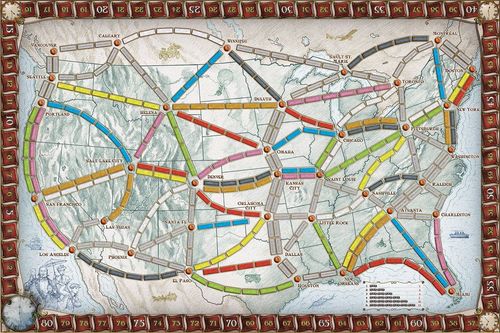
As I have already said, Ticket To Ride is a very simple game. (Keep in mind, I am only analyzing the original here, not any of the variations/expansions.) Along those lines, there are a few small things to design that are very important (for instance, only being able to lay down one length of track at a time, as opposed to being able to lay multiple) to the game's fine-tuned gameplay, but there is only one other major piece that contributes to its greatness. That is the map.
The map is clearly been play-tested and balanced well. The choices were well made when considering where the double lines are and where the short versus long lines are. Without a well thought-out, balanced map, the game could quickly become a simple question of: Did you get the good route or the sucky route? The game is not completely free of that. One can still get stuck with a bunch of short routes on the East coast, making it difficult to build up routes, but the tickets are also well balanced with the map. So, if one grabs more tickets (and they can choose 1 of 3, which is also key to not getting screwed over and reducing randomness), they are likely to get a set of routes with a good mix of long and short lines between cities. It is so refreshing to see such a great map. It would have been very easy for the designers to make it anyway they wanted and just leave it at that, causing a gameplay problem where players that get certain routes always win. However, there are many routes and, as already stated, the line length and placement of double lines is well done; so, they game is allowed to flourish. It has flourished too. It has sold very well, is widely considered one of the best strategy games out there, and is one of my top 3 or 4 favorite games.
So, as we normally do on this blog, let's analyze what makes the game, in this case Ticket To Ride, so great. First of all, the rules are simple. Players may not understand right away, but it will only take a turns and they will have the hang of it. People cards, they play those cards to lay track, only one player can use each track, and they want to complete the routes on their tickets any way they can. The nice thing about this simplicity is that it still allows enough variation for one's strategy to change every game in terms of how many tickets they take, when they lay down trains, and where they they their trains. (In other words, it is not too simple.)
Second, the train cards (which players use to lay down trains) always have 5 out, face-up at time. Players can choose from those 5 or take 1 off the top of the shuffled deck. Randomness is always something that strategy games need to mitigate and having 5 cards out accomplishes that mitigation nicely. Certainly, sometimes the randomness still ruins a player in that the color they need doesn't show up; nevertheless, it is much, much better than if players always had to draw off the top, being completely subject to the randomness of the deck. In fact, I am certain that Ticket To Ride would be ruined if players always had to draw a unknown card off the deck instead of having the chance to choose from 5 known cards.
As I have already said, Ticket To Ride is a very simple game. (Keep in mind, I am only analyzing the original here, not any of the variations/expansions.) Along those lines, there are a few small things to design that are very important (for instance, only being able to lay down one length of track at a time, as opposed to being able to lay multiple) to the game's fine-tuned gameplay, but there is only one other major piece that contributes to its greatness. That is the map.
 |
| Taken from Games By Johnny blog. If wished, I can take down and use a different pic. |
Sunday, July 17, 2011
Rethinking and new thinking: maps and movement
 |
| Taken from image gallery for The Haunting House on boardgamegeek.com |
I would guess (and could be wrong) that a inexperienced, American gamer would probably first think of just using squares. Certainly, traditional board games like Monopoly and Sorry used squares. There might be those who despise traditional, roll-and-move games with their squares, but that doesn't mean that squares should be dismissed outright. For example, the Haunting House is a game that uses squares in a fairly ingenious way.
In the Haunting House, one must follow the path on the hallway tile, but they cannot go through walls even though some of the tiles bump into or end at walls. So, of course, they also cannot move diagonally. The players have cards that can turn the tiles in various ways to achieve the path they need. Now, the Haunting House has some other problems to where it is a game that I cannot recommend (I gave my copy away.), but the tiles set up to dictate the movement is very interesting.
 |
| Space Hulk image from gallery at boardgamegeek |
Of course, if you want the players to move freely around the map in any direction, then squares may not work too well as moving diagonally is a little awkward since the diagonal tiles do not touch each other. Also, the player can move left (or right) and up in one move by moving diagonally forward. That can create problems with the design's rules regarding how and how-much a player can move in a turn. So, in such a case, many games use hexagons.
 |
| boardgamegeek image gallery pic |
So, it would seem that is it: use a map of squares if you want restricted, hallway or path types of movement; use a hexagonal map if you want the players to have the most freedom of movement. I would completely agree. However, the one case in which a designer might want to think of another way to do free movement is if they are programming the game. For instance, board games seem to becoming more popular on the iPad and iPhone; so, a designer might expect that their game would have a iOS version as well. As a old article by Tanstaafl on GameDev.net points out, programming a hexagonal map is fairly complex. So, now one might want to think of a easier way to create what I call a "free-movement map." It might make development much easier in many ways, at the very least reducing development time. This is where the new thinking comes in. What different shapes can be used? One could make strange shapes. For instance, Risk uses country shaped regions that don't have a set or shape. Then again, a set size and shape can be easier for programming. So, one might use a isometric map as Tanstaafl speaks of. However, is that easy enough? Isometric maps look possibly even move difficult than hexagonal. Maybe it is time a game designer thought of a new way to govern movement and spaces in games dependent on a map. What could those be? Maybe squares and hexes together, creating some separated areas and some completely connected would be an option. Maybe not using boundaries but instead using intersecting lines like Go would allow for easy development and needed freedom in movement. This is the type of discussion I find very interesting as examine game development and design. It might be that all the good options (squares, hexagonal, & isometric) have already been thought of, but I will continue to ponder the options. If a new way can be thought of, maybe it might open opportunities for game mechanics that hexagonal maps don't accomodate as well. Who knows? Regardless of the outcome, it is a intriguing examination that can really drive the atmosphere and other mechanics of a game.
Sunday, July 10, 2011
Back To The Future: The Card Game, and quick thought(s) on randomness in games
I recently purchased Back To The Future: the card game, and I have played it a few times. I have also recently gotten back into playing Risk, specifically one game of Risk 2210 and a few games on ConquerClub.com. They both have a strong element of randomness (Risk simply with the reliance on dice rolls to resolve combat.) It really gets one thinking about randomness in games because it can be fun, infuriating, or both. Back to the Future: the card game is a perfect example of both. The game is designed well enough to where the randomness in it can lend to some light-hearted fun, but the random elements can ruin some sessions of the game as well.
To give a little background first: The main goal in the game is to flip the timeline cards to have the events that fit those on your role card. Once a player has all his/her events set, he/she flips a certain card (B1 in the timeline) to see if they won.
The method in which the timeline is implemented is brilliant. The players line out cards, which represent a timeline. Using the cards in one's hand (as a player of course) one can flip some of those cards. On the other side of the card is a different version of the event. For example, Lorraine marries Biff instead of marrying McFly. This of course affects the timeline and changes other events. So, if one card is flipped, then at least one more card will have to be flipped and multiple other timeline cards could be flipped. This really gives a great feel of really playing with time, and I think that feeling would be very hard to achieve any other way. I must interject with a negative point, however. The timeline and how/when to turn what cards is confusing. When I first played this with my lunch group, we played the game wrong 3 times before we completely played it correctly. So, while I think the timeline is the best part of the game, I really feel it needs some polish. It needs to be simplified somehow without losing the fun of watching more than one card flip when some other cards (called linchpins) are flipped.
The second good point is that the game says it is for 2-6, and it really is good with any # of those players. As you can find by reading my post on Space Hulk: Death Angel, not all games are actually fun with any # of players the game says it can handle. However, this requires a bit of a negative or qualifier point as well. The more players you have, the more likely you are to be fighting over linchpins, which flip other cards. This means the game is likely to go longer. Now, B1 is the card one flips to see if he/she wins. There are 6 of those cards and only one says "you win." If you don't flip that card, you discard the B1 card you flipped; then you need to play another card (usually in your next turn) to flip B1 again and see if you win. If you flip the winning B1 card pretty early on (like by the 3rd one down at most), then it doesn't matter; the game usually ends fast enough. However, if the winning B1 card is stuck 5th or 6th from the top, the game can drag on too long; people start to get bored, and the game becomes a chore to finish instead of fun. So, my point here in a nutshell is this:
1) The game CAN play well with 2-6 players
2) This is a game that really needs to be no more than 30-35 minutes to set up and play.
3) The more players you have the more likely you are to go over that 35 minute mark.
Nevertheless, I would still say the game is not best with 2 players. I would say it is best with 3-4.
Now, I haven't played Back To The Future: the card game very much, but it doesn't take long to notice that it is dominated by randomness. There are cards that allow you to cancel another player's turn. There are cards that force you to give your entire hand (not including your role card) to another player. There are even cards that make you switch your role, changing the events you need to set on the board in order to flip B1 and win. This randomness can be fun. Certainly, the game is supposed to have some goofiness to it, and the designer clearly wants it to be light fun accessible to almost any age. The random elements in the game achieve that. However, they also are the reason why it is not fun if it takes over 35 minutes to play. When no one can properly build and maintain a strategy to win the game, the game becomes frustrating. If it goes fast, it was fine. One plays a quick game, sets it aside, and moves on to another game (or maybe they go read a book or something). However, it is not one in which you want to find the best way to make your cards work for you or one in which you really want to do much of any strategy. That is why it must be a short game time, and that is also why one won't play it multiple times in a row. It is more like what is called a "filler game" that one plays to fill a short time or one that people might play for something quick before a "meatier" game like Carcassonne or Dominion is played.
Speaking of Dominion, that is a game where one can really build a strategy and see it come to fruition. However, even it has some randomness in the shuffling of some cards. Every game must have randomness, but there are degrees, and Back To The Future has a little too much. It is still fun, but I would love to get a version of that game that wasn't so random and, thus, had a larger strategy element.
To give a little background first: The main goal in the game is to flip the timeline cards to have the events that fit those on your role card. Once a player has all his/her events set, he/she flips a certain card (B1 in the timeline) to see if they won.
The method in which the timeline is implemented is brilliant. The players line out cards, which represent a timeline. Using the cards in one's hand (as a player of course) one can flip some of those cards. On the other side of the card is a different version of the event. For example, Lorraine marries Biff instead of marrying McFly. This of course affects the timeline and changes other events. So, if one card is flipped, then at least one more card will have to be flipped and multiple other timeline cards could be flipped. This really gives a great feel of really playing with time, and I think that feeling would be very hard to achieve any other way. I must interject with a negative point, however. The timeline and how/when to turn what cards is confusing. When I first played this with my lunch group, we played the game wrong 3 times before we completely played it correctly. So, while I think the timeline is the best part of the game, I really feel it needs some polish. It needs to be simplified somehow without losing the fun of watching more than one card flip when some other cards (called linchpins) are flipped.
The second good point is that the game says it is for 2-6, and it really is good with any # of those players. As you can find by reading my post on Space Hulk: Death Angel, not all games are actually fun with any # of players the game says it can handle. However, this requires a bit of a negative or qualifier point as well. The more players you have, the more likely you are to be fighting over linchpins, which flip other cards. This means the game is likely to go longer. Now, B1 is the card one flips to see if he/she wins. There are 6 of those cards and only one says "you win." If you don't flip that card, you discard the B1 card you flipped; then you need to play another card (usually in your next turn) to flip B1 again and see if you win. If you flip the winning B1 card pretty early on (like by the 3rd one down at most), then it doesn't matter; the game usually ends fast enough. However, if the winning B1 card is stuck 5th or 6th from the top, the game can drag on too long; people start to get bored, and the game becomes a chore to finish instead of fun. So, my point here in a nutshell is this:
1) The game CAN play well with 2-6 players
2) This is a game that really needs to be no more than 30-35 minutes to set up and play.
3) The more players you have the more likely you are to go over that 35 minute mark.
Nevertheless, I would still say the game is not best with 2 players. I would say it is best with 3-4.
Now, I haven't played Back To The Future: the card game very much, but it doesn't take long to notice that it is dominated by randomness. There are cards that allow you to cancel another player's turn. There are cards that force you to give your entire hand (not including your role card) to another player. There are even cards that make you switch your role, changing the events you need to set on the board in order to flip B1 and win. This randomness can be fun. Certainly, the game is supposed to have some goofiness to it, and the designer clearly wants it to be light fun accessible to almost any age. The random elements in the game achieve that. However, they also are the reason why it is not fun if it takes over 35 minutes to play. When no one can properly build and maintain a strategy to win the game, the game becomes frustrating. If it goes fast, it was fine. One plays a quick game, sets it aside, and moves on to another game (or maybe they go read a book or something). However, it is not one in which you want to find the best way to make your cards work for you or one in which you really want to do much of any strategy. That is why it must be a short game time, and that is also why one won't play it multiple times in a row. It is more like what is called a "filler game" that one plays to fill a short time or one that people might play for something quick before a "meatier" game like Carcassonne or Dominion is played.
Speaking of Dominion, that is a game where one can really build a strategy and see it come to fruition. However, even it has some randomness in the shuffling of some cards. Every game must have randomness, but there are degrees, and Back To The Future has a little too much. It is still fun, but I would love to get a version of that game that wasn't so random and, thus, had a larger strategy element.
Subscribe to:
Posts (Atom)
1) User reviews can be a great help and asset when a buyer needs a few more opinions, but are often not enough by themselves. A site solely of user reviews is not a useful site at all.
WHY?
Several reasons.
a) you do not want to spend time reading a review if it is off base or you just plain don’t agree. So, you have to depend on user Yay/Nay votes. However, these are often misleading.
– users often vote down (Nay) a review simply because it speaks poorly of a game they like, even if the review is accurate and well written.
– users may up vote (Yay) a review just because it gives a few sentences they agree with. The review may not say nearly enough to be useful, but they “Yay” it because they agree with the sentiments.
b) user reviews are often too short, too long, or not clear and, sadly, there isn’t any way to guarantee (or even necessarily get a high likelihood) of quality reviews.
c) even if the review is quality, it can be hard to determine if the game is for you. Maybe the reviewer is very harsh on the randomness in the game because they hate ANY randomness. Maybe you don’t mind randomness as much and it wouldn’t bother you so much.
SOLUTION:
* You need some regular, official reviewers that users can get to know. Example: When a GiantBomb.com editor reviews a game, I have read enough of their reviews that I know what they like and dislike. So, if they say they hate the inventory management, I know whether to take that “with a grain of salt” or whether to really take note because they don’t usually have a problem with such things. All those problems I mention above can be avoided via regular, official reviewers. You can be sure they write solid reviews because you have chosen them in response to good reviews they’ve written. The users know how to evaluate their reviews because they learn their likes/dislikes.
WE CAN’T PAY ANYONE. HOW CAN WE DO THIS?
I would suggest starting with scouring the site for users that regularly write good reviews (or even a few good reviews without any poor ones). Email them and ask if they would be willing to be a official, boardgaming.com reviewer. You could put a special stamp on their profile and reviews. You might request that they just review one game every one or two months. That isn’t too much to ask. Heck, I’d love to do that (yes, for free). If needed you could add incentive by giving them earlier access to new features or something.