So, as we normally do on this blog, let's analyze what makes the game, in this case Ticket To Ride, so great. First of all, the rules are simple. Players may not understand right away, but it will only take a turns and they will have the hang of it. People cards, they play those cards to lay track, only one player can use each track, and they want to complete the routes on their tickets any way they can. The nice thing about this simplicity is that it still allows enough variation for one's strategy to change every game in terms of how many tickets they take, when they lay down trains, and where they they their trains. (In other words, it is not too simple.)
Second, the train cards (which players use to lay down trains) always have 5 out, face-up at time. Players can choose from those 5 or take 1 off the top of the shuffled deck. Randomness is always something that strategy games need to mitigate and having 5 cards out accomplishes that mitigation nicely. Certainly, sometimes the randomness still ruins a player in that the color they need doesn't show up; nevertheless, it is much, much better than if players always had to draw off the top, being completely subject to the randomness of the deck. In fact, I am certain that Ticket To Ride would be ruined if players always had to draw a unknown card off the deck instead of having the chance to choose from 5 known cards.
As I have already said, Ticket To Ride is a very simple game. (Keep in mind, I am only analyzing the original here, not any of the variations/expansions.) Along those lines, there are a few small things to design that are very important (for instance, only being able to lay down one length of track at a time, as opposed to being able to lay multiple) to the game's fine-tuned gameplay, but there is only one other major piece that contributes to its greatness. That is the map.
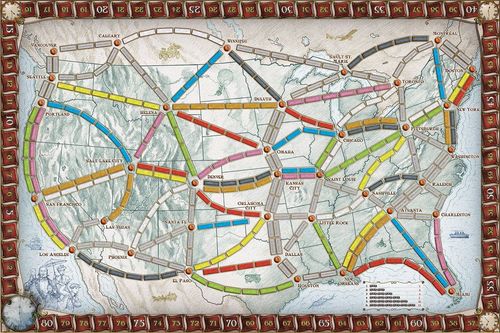 |
| Taken from Games By Johnny blog. If wished, I can take down and use a different pic. |

No comments:
Post a Comment